Midnight Musings is a collection of reflections on delivery leadership, enterprise chaos, AI transformation, and the human side of program management.
Written from years spent inside escalations, governance calls, and transformation programs that looked far cleaner in PowerPoint.

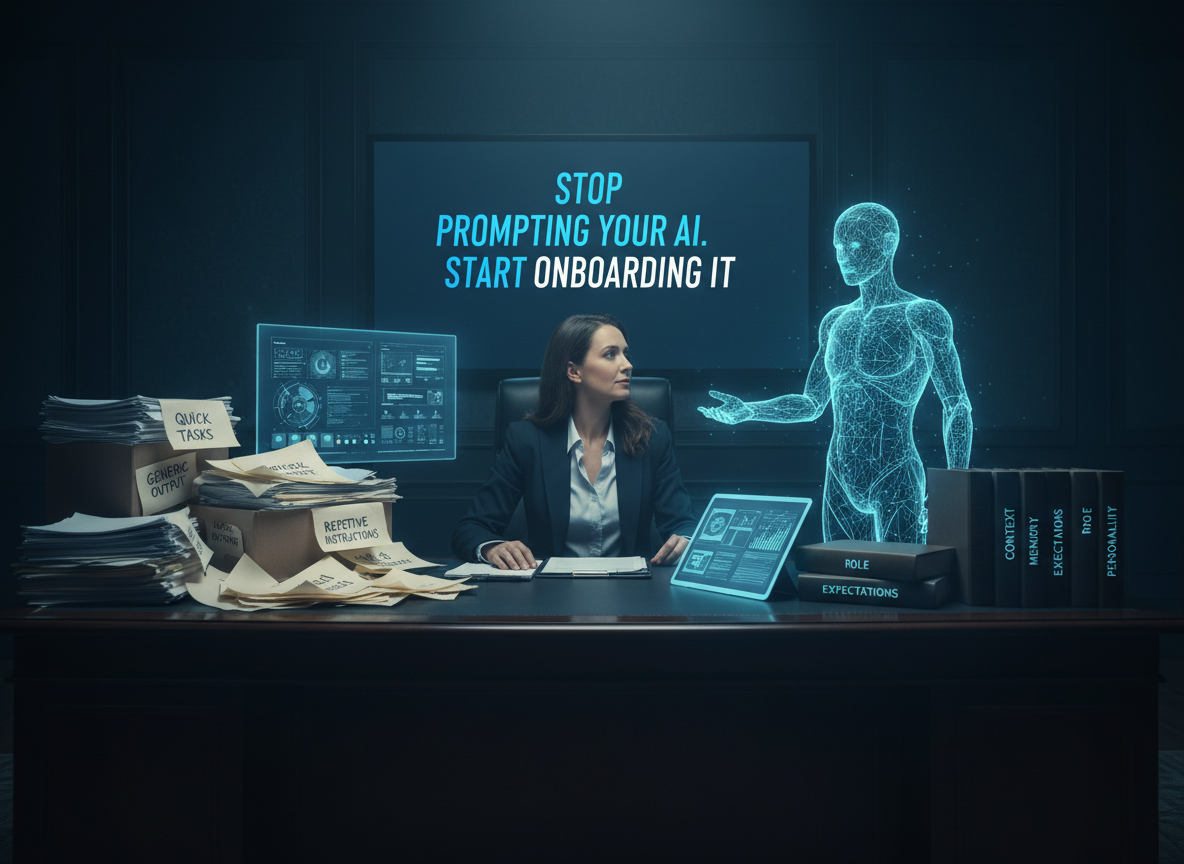
  • Stop prompting your AI. Start onboarding it.


    The more I use AI, the less I think about prompts. Sounds backwards. It isn’t.

    It’s 8:40am on a Monday.

    A new colleague joins your team. Experienced. Sharp. The kind of hire you fought to get.

    You walk over, drop a single sentence on their desk – “I need the risk summary for the steering meeting by four” – and walk away.

    No background. No customer history. No last month’s status. No sense of who’s in the room at four, or what actually keeps them up at night.

    At 3:58pm, it lands in your inbox.

    It’s… fine. Technically correct. Neatly formatted. And completely generic. It tells you what happened. It doesn’t tell you what matters. It walks straight past the two things you actually needed decided.

    Would you blame the new hire? Of course not. You’d blame the onboarding.

    And yet – this is exactly how most of us use AI. We hand it a task, give it almost nothing, expect brilliance, and then mutter that “AI isn’t that good for our kind of work.

    The problem is rarely the intelligence in the room. It’s the brief.


    AI doesn’t need a better prompt. It needs better context.

    When people find out how much I lean on AI at work, they usually want my prompts. The magic words. The secret template. They look genuinely let down when I tell them the prompt is the least interesting part.

    The biggest jump in how I use AI had nothing to do with cleverer phrasing. It came from one boring shift: I stopped treating AI like software, and started treating it like a new team member.

    You don’t fling work at a new joiner on day one. You sit them down. You explain what you’re trying to achieve, who the stakeholders are, how decisions really get made, what “good” looks like, which landmines to avoid. Then you let them run.

    AI deserves the same courtesy. And the results scale with the briefing, not the wording.


    The quiet shift: from Prompt Engineering to Context Engineering

    For a few years the whole conversation has been about Prompt Engineering – how to phrase the perfect instruction.

    It worked. Better prompts do give better answers.

    But a related discipline is becoming increasingly important: Context Engineering; deliberately giving AI the knowledge, history and constraints it needs to understand a problem before you ask it to solve one.

    Prompt Engineering tells AI what you want it to do. Context Engineering gives AI what it needs to know before doing it.

    Take a request I make constantly: “Review this and give me the three biggest risks.”

    I could spend ten minutes perfecting that sentence. Or I could give it something far more useful – the objectives, the last few updates, the key decisions, the customer commitments, the open issues, and what’s already gone wrong.

    The prompt didn’t get smarter. The model didn’t get smarter. But the answer almost certainly did.


    Information isn’t the same as context

    Anyone who’s joined something halfway through knows this in their bones.

    You get the shared drive link. You read the reports, the plan, the minutes. Hours of heroic document-reading later, you technically possess a mountain of information – and still can’t say why the team is doing what it’s doing.

    Because the most valuable context is rarely in a document. It’s the history behind a decision. The tension between two stakeholders. The thing that was tried six months ago and blew up. The reason the “obvious” option isn’t actually on the table.

    Information tells you what happened. Context tells you why it matters.

    For small tasks – rewrite this email, summarise that doc – the task itself carries enough. But the moment you ask AI to analyse a situation, challenge your thinking, or connect today with a decision made three weeks ago, the depth of its context is everything.


    How I actually onboard AI – in five steps

    This is the routine I run before asking AI for anything that matters. It adds minutes to the front of the task and can save hours on the back end. Whether you’re a fraud analyst, a compliance lead, a project manager, or in sales.

    1. Hire it for a role, not a task. Don’t say “write a project update.” Say “You’re a program manager briefing an executive committee that cares about outcomes, risk, budget and the decisions that need attention today.” Need a different brain? Hire a different person – a business analyst, a skeptical customer CIO, a risk manager. Same AI, different seat, completely different answer.

    2. Finish the onboarding. Hand it what you’d hand a real joiner: the objectives, the recent history, the open issues, the stakeholders, and – quietly one of the most useful – how this particular customer likes to be communicated with.

    3. Tell it what “good” looks like. AI rarely struggles to do the work; it struggles to know what good is. So spell it out: highlight only material changes, challenge the optimistic assumptions, keep it under a page, recommend a decision – don’t just narrate status.

    4. Coach the first draft. Don’t stop at the first answer. Turn around and interrogate it: What did you assume? Which risk haven’t we surfaced? If you were the customer, what would worry you? Which of your own recommendations is weakest? This is where it stops being a writing tool and starts being useful – not because it writes well, but because it critiques well.

    5. Let it keep the memory. Good people compound because they remember. Keep the context alive – living docs, a decision log, lessons learned – so every conversation starts where the last one ended.

    And you don’t need a complicated AI stack to do this. If you have Microsoft Copilot, you already have most of what you need to start. Bring the relevant project documents, meeting notes, plans and status reports into the conversation or approved workspace, give Copilot the role and success criteria, and then start asking it to challenge your thinking.

    What a good brief actually looks like Role: You’re a compliance analyst preparing a summary for the MLRO. Context: here’s the alert history, the policy, last quarter’s findings, the customer profile. What “good” means: flag only material changes, call out anything inconsistent, recommend an action – keep it to half a page. Then ask. Then coach. Two extra minutes of briefing saves twenty minutes of rewriting.


    This isn’t just my habit – it’s where everything is heading

    Context Engineering isn’t a personal quirk. Most of the AI around us is already evolving toward it.

    Projects in ChatGPT and Claude let your files and history live around your work. Gemini Notebook reasons inside a stack of sources you choose. GitHub Copilot works with the surrounding codebase, not orphaned snippets. And it’s in your pocket too – Siri learning across your messages and mail, Gemini drawing on Gmail, Photos and Calendar.

    Different tools, same direction: AI gets more useful when it understands the environment the question lives in.

    Security Considerations

    One important line in the sand, though – especially at a company like ours. Context Engineering is not a license to paste sensitive material into whatever AI tab is open. Customer data, confidential information, source code and IP stay inside approved tools and our security policies. The goal was never maximum context. It’s the right context, securely, at the right moment.


    A better question to ask

    Prompt Engineering isn’t going away. Clear instructions always matter.

    But next time AI hands you a mediocre answer, resist the reflex to rewrite the prompt. Ask instead:

    What do I know that the AI doesn’t?

    The history in your head. The constraint you never spelled out. What “good” looks like to you. What you’d tell a sharp colleague before handing them the same task. Give AI that, and ask again.

    Before your next AI conversation, don’t open with the task. Open with the onboarding – five quick questions:

    •  Who have I hired it to be?

    •  What does it need to know first?

    •  What does “good” look like here?

    •  How will I coach the first draft?

    •  What should it remember for next time?

    You’ll spend two extra minutes briefing it. You’ll save twenty rewriting it. And somewhere in there, you’ll stop treating AI as software that answers questions – and start treating it as a teammate that helps you solve them.

    Which leaves the question I keep circling back to: if context makes AI this much better, how do we stop rebuilding it from scratch every single conversation?

    That’s where the idea of a Second Brain starts to get interesting.

    But that’s for another day.

    Midnight Musings... from the trenches of delivery.

    https://www.linkedin.com/pulse/stop-prompting-your-ai-start-onboarding-rahul-majumdar-7saaf
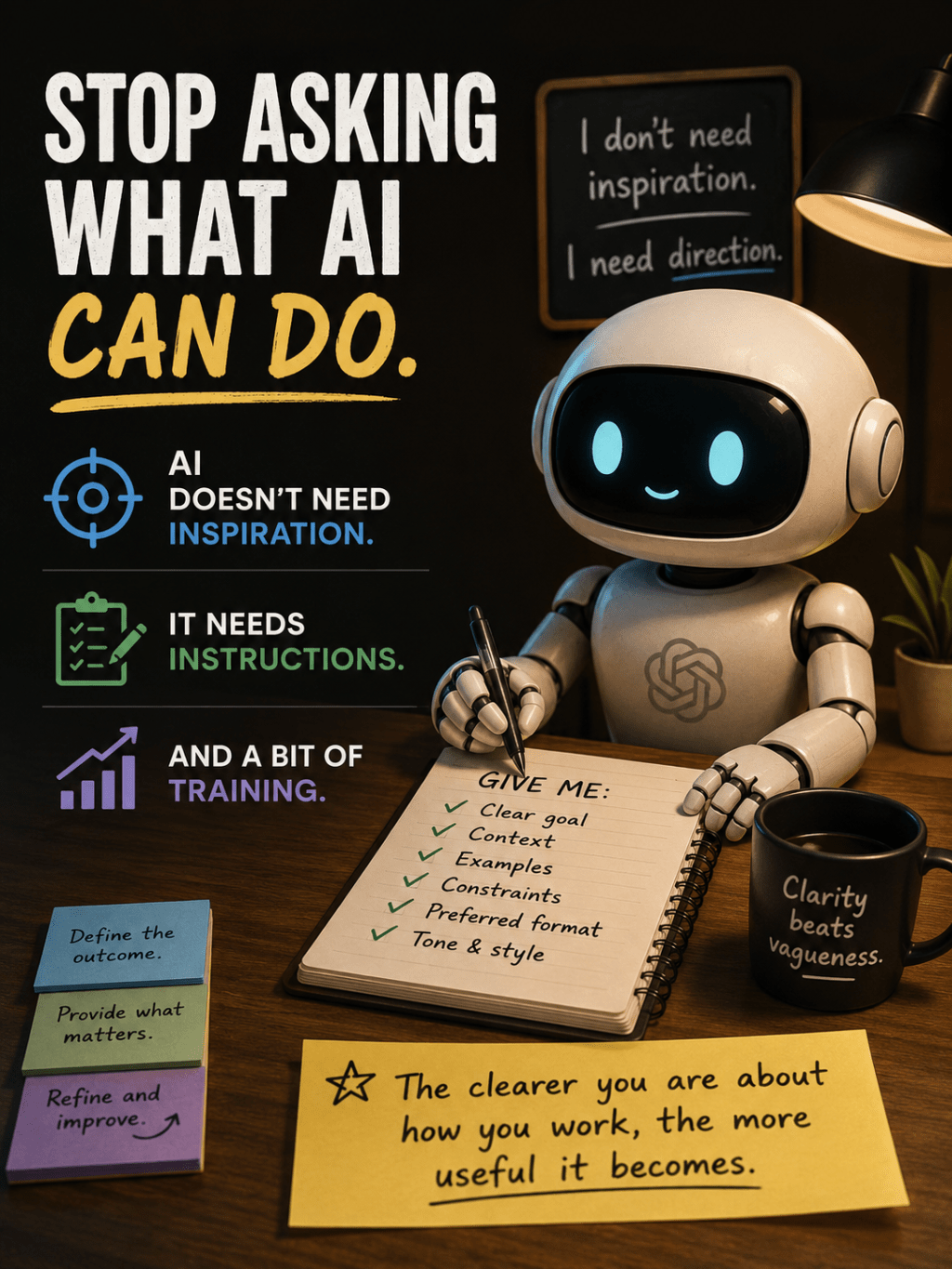
  • Stop Asking What AI Can Do

    Stop Asking What AI Can Do

    Most people ask the wrong question about AI.

    “What can AI do for me?”

    That’s like hiring someone and then asking what skills they happen to have. Nobody competent works that way.

    You start with the job. You define what you need. You break the work down. Then you hire for that. And once you hire, you train. You give context. You correct. You refine.

    AI is no different.

    Look at your actual day. Status updates. Follow-ups. Notes. Deck edits. Repeating yourself in different formats. Break that chaos into the smallest possible tasks and hand them off.

    AI doesn’t need inspiration. It needs instructions. And a bit of training. The clearer you are about how you work, the more useful it becomes.

    Used this way, it’s not a replacement. It’s leverage. It doesn’t change who you are. It just gives you more surface area to operate.

    Stop admiring the tool. Start assigning it work.

    #midnightmusings from the trenches of delivery.

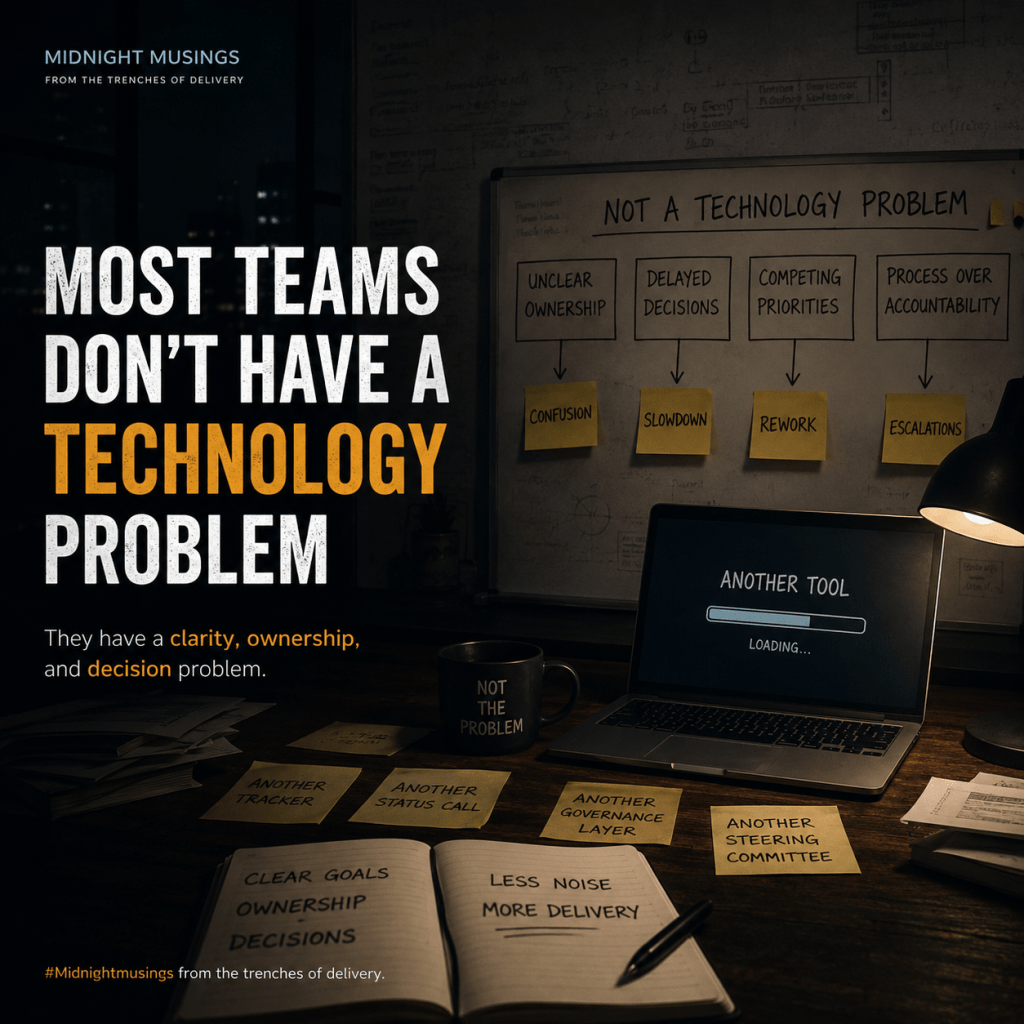
  • Most Teams Don’t Have a Technology Problem

    Most Teams Don’t Have a Technology Problem

    One of the strangest habits in delivery is how quickly troubled programs blame technology.

    Deadlines slip?
    Must be the platform.

    Escalations rise?
    Probably architecture.

    Delivery slows down?
    Clearly a tooling issue.

    But most program failures are not caused by technology limitations.

    They come from unclear ownership, delayed decisions, competing priorities, and teams that slowly normalize confusion.

    The response is usually predictable:

    • another tracker
    • another status call
    • another governance layer

    Because process feels safer than accountability.

    Technology becomes the visible villain because it is easier to debug systems than confront operating behavior.

    Most struggling programs already have good enough technology.

    What they lack is operational clarity.

    Clear ownership.
    Faster decisions.
    Less ambiguity.

    Simple.
    Difficult.
    Rare.

    #Midnightmusings from the trenches of delivery.

  • Right Person. Wrong Role.

    Right Person. Wrong Role.

    One of the hardest parts of leadership is accepting that good people can still be wrong for a role.

    I once heard Girish say:
    “Right person for the right job.”

    Simple sentence. Difficult responsibility.

    Because eventually every leader faces the same uncomfortable reality:
    the person may be hardworking, loyal, and trying their best – and still not be the right fit anymore.

    You see it slowly.
    Missed ownership.
    Repeated escalations.
    The team quietly compensating in the background.

    And this is where leaders hesitate.

    Not because they don’t see the problem.
    Because they do.

    They delay the conversation hoping time will solve what clarity already knows.

    But keeping the wrong person in the wrong role too long is unfair to everyone involved – especially them.

    Hard decisions do not require emotionless leadership.
    They require calm leadership.

    Be prepared with data.
    Be clear.
    Don’t over-explain yourself.

    The best leaders handle difficult decisions quietly.
    No drama.
    No corporate theater.
    Just clarity.

    Because delayed decisions rarely become easier.
    They usually become expensive.

    #midnightmusings from the trenches of delivery.

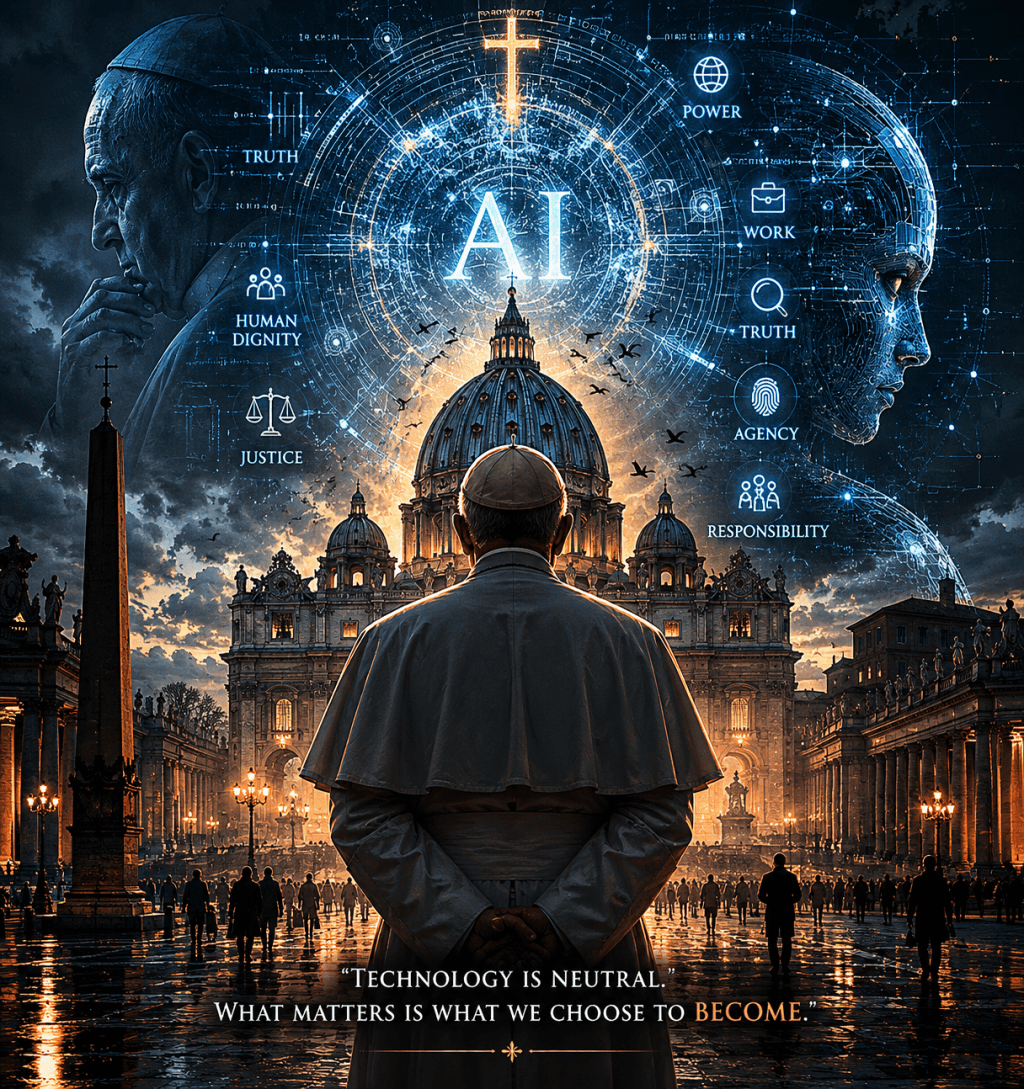
  • When the Vatican Starts Writing About AI

    When the Vatican Starts Writing About AI

    Pope Leo XIV just released a 245-page encyclical on Artificial Intelligence.

    You know things are getting serious when a 2,000-year-old institution decides AI needs formal doctrine.

    The Vatican’s new AI encyclical is not really about technology. It’s about power, labor, truth, identity, and what happens when human intelligence itself becomes industrialized.

    That’s the shift.

    AI is no longer a “tech trend.”
    It is becoming infrastructure for society itself.

    The Church has historically stepped into moments where technology reshaped humanity:

    • Industrialization
    • Nuclear weapons
    • Global capitalism

    Now AI joins that list.

    And beneath the religious framing sits an uncomfortable secular reality:
    Every major institution now understands AI is going to fundamentally alter how civilization operates.

    Governments.
    Education.
    Media.
    Law.
    Work.
    Trust.
    Human agency itself.

    This is no longer a conversation about productivity tools or chatbot demos.

    Once institutions built to think in centuries start treating AI as a moral and societal question, you are no longer in an innovation cycle.

    You are in an epoch shift.

    Humanity, naturally, appears determined to navigate this transition with deep wisdom and maturity. Right after deepfake propaganda, autonomous weapons, and emotionally dependent chatbot relationships. Spectacular species behavior.

    #Midnightmusings from the trenches of delivery.

    Visuals by AI. Reflections by experience.

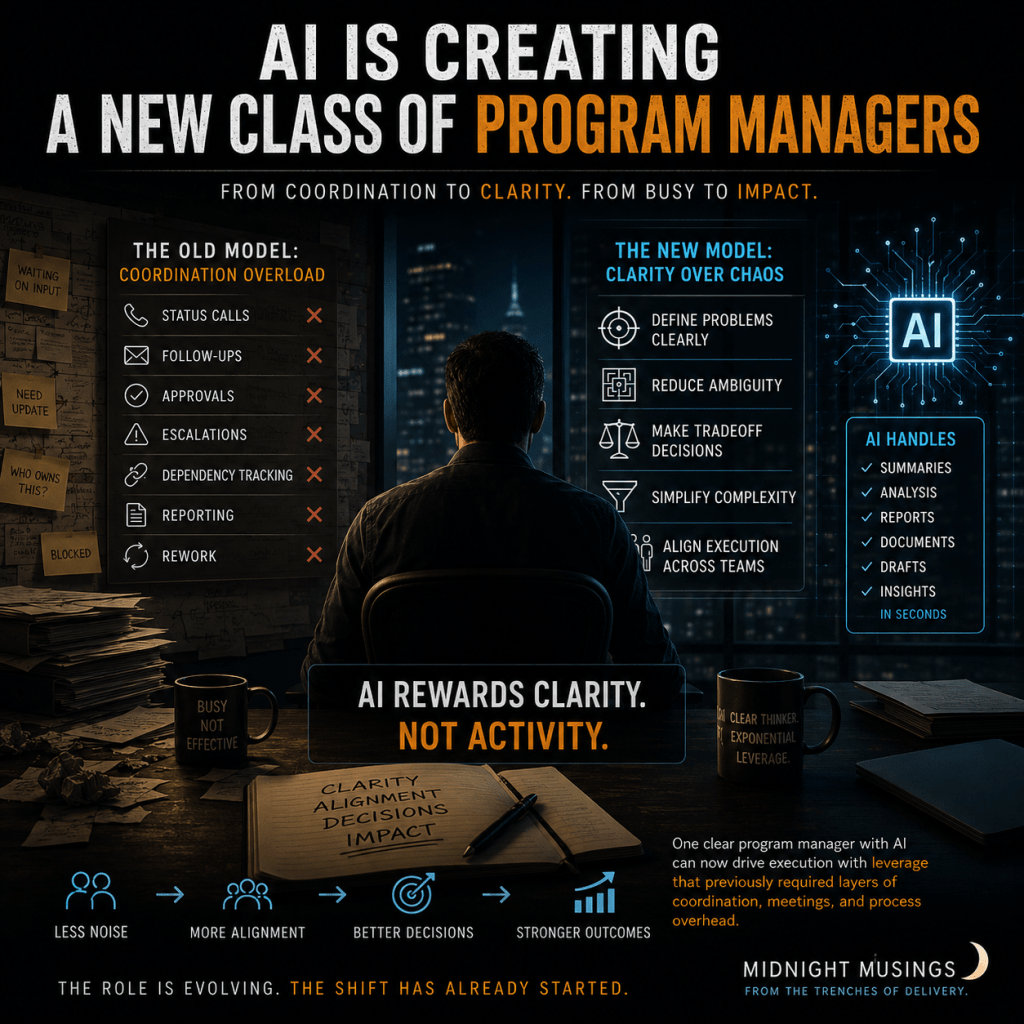
  • AI Is Creating a New Class of Program Managers

    AI Is Creating a New Class of Program Managers

    For years, program management optimized around coordination.

    Status calls.
    Follow-ups.
    Approvals.
    Escalations.
    Dependency tracking.

    A large part of program management became operational middleware between disconnected teams, systems, and stakeholders.

    AI is starting to change that.

    Not because it replaces delivery managers.
    Because it commoditizes execution support.

    Presentations, summaries, reporting, analysis, documentation, planning drafts. Machines can now generate acceptable first versions in seconds.

    The advantage is shifting elsewhere.

    Toward delivery leaders who can:

    • define problems clearly
    • reduce ambiguity
    • make tradeoff decisions
    • simplify complexity
    • align execution across teams

    AI rewards clarity.
    Not activity.

    The highest-value delivery managers are no longer the people producing the most artifacts.

    They are the ones creating the most alignment.

    Because one clear operator with AI can now drive execution with leverage that previously required layers of coordination, meetings, and process overhead.

    The role is evolving faster than most organizations realize.

    And the shift has already started.

    #Midnightmusings from the trenches of delivery.

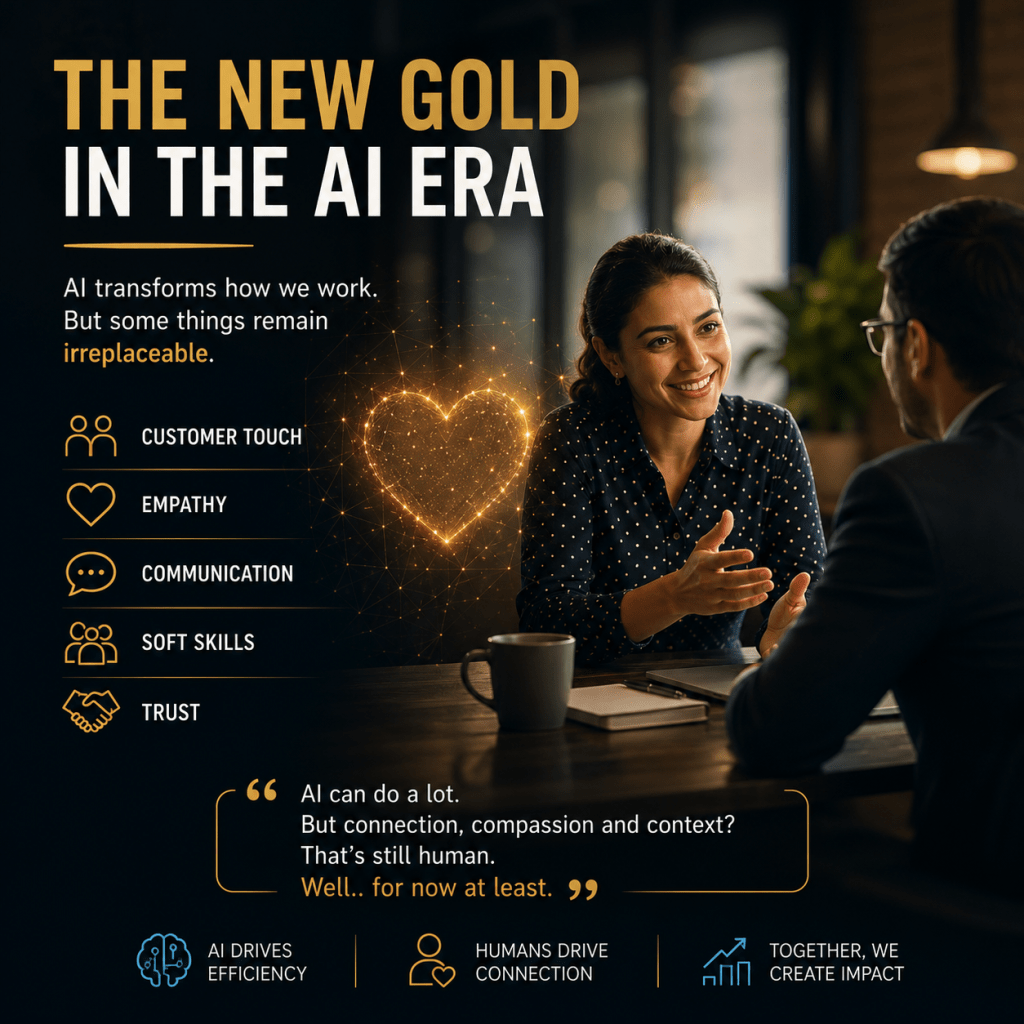
  • Being Human

    Being Human

    Just got back home from a Leadership AI Summit at NICE.

    Leaders across Product, R&D, Services, and Support spoke about how the workforce is evolving and how processes are evolving to adapt to an AI-driven world.

    There was a lot of healthy discussion around AI-enabled delivery, AI-DLC, workforce transformation, domain breadth, and solution expertise.

    But one thing stood out clearly through all of it.

    While technology evolves, one thing still stays the same.

    The customer experience.
    The human touch.
    Empathy.
    Communication.
    Soft skills.
    The ability to build trust, calm uncertainty, and connect with people.

    That remains irreplaceable.

    AI can accelerate execution.
    It can summarize, automate, recommend, and optimize.

    But it still cannot truly replace the human ability to understand context, navigate emotion, and build relationships during moments that matter.

    Well… not yet at least.

    Ironically, the more AI advances, the more valuable these deeply human skills become.

    That may very well be the new gold.

    #Midnightmusings from the trenches of delivery.

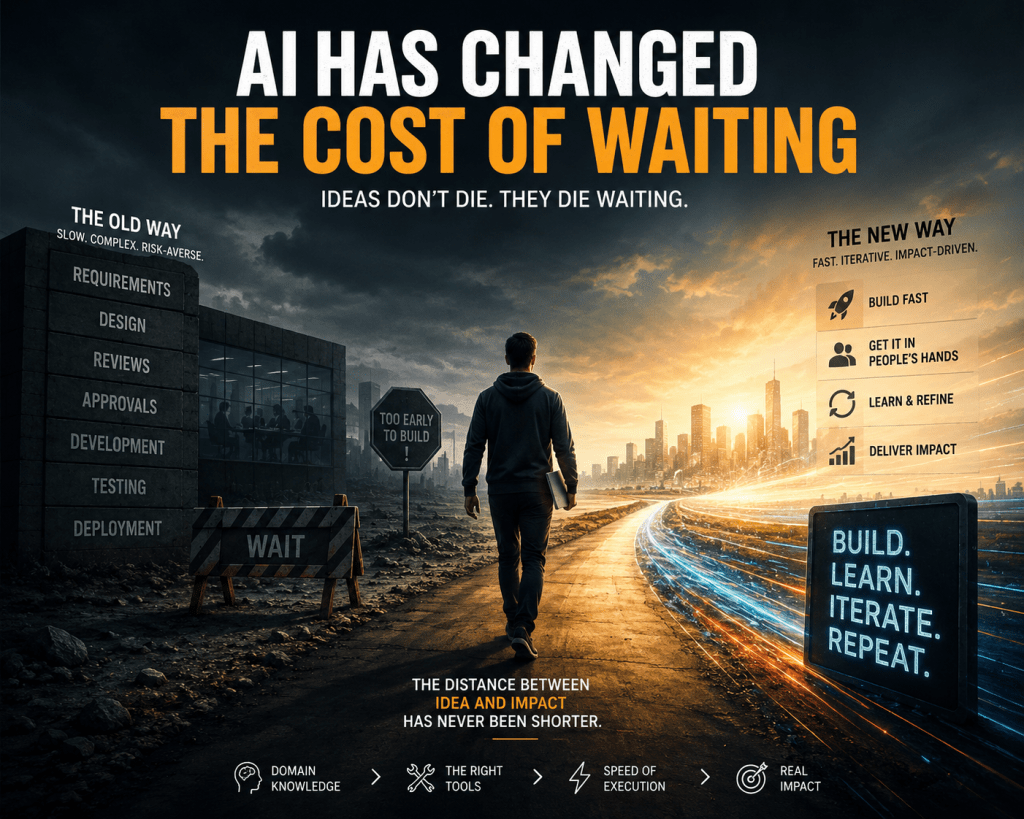
  • AI Has Changed The Cost of Waiting

    AI Has Changed The Cost of Waiting

    In the last post, I wrote about how the people winning with AI aren’t necessarily the best coders.

    They’re the people who understand their domain deeply enough to build.

    But there’s another shift happening underneath that.

    Speed.

    A few months ago, I watched two very different approaches to the same AI-driven idea.

    One treated it like a traditional software project:
    planning, reviews, alignment, architecture discussions, phased execution.

    The other approach was simpler:
    build fast, get it into people’s hands, refine as you go.

    That contrast stayed with me.

    Because AI is collapsing the distance between idea and execution.

    A domain expert with clarity and the right tools can now prototype faster than many organizations can align internally.

    And that changes things dramatically.

    The advantage is no longer just technical skill.

    It’s speed of understanding.
    Speed of iteration.
    Speed of decision-making.

    Many organizations are still operating with waterfall thinking in a world where experimentation has become almost free.

    AI rewards people who are hands-on.
    People close to the actual business problem.
    People willing to fail fast and refine in public.

    Which raises an uncomfortable question:

    If everyone starts building this quickly, what happens to stability, architecture, governance, and long-term maintainability?

    That’s probably where the real conversation begins.

    #Midnightmusings from the trenches of delivery.

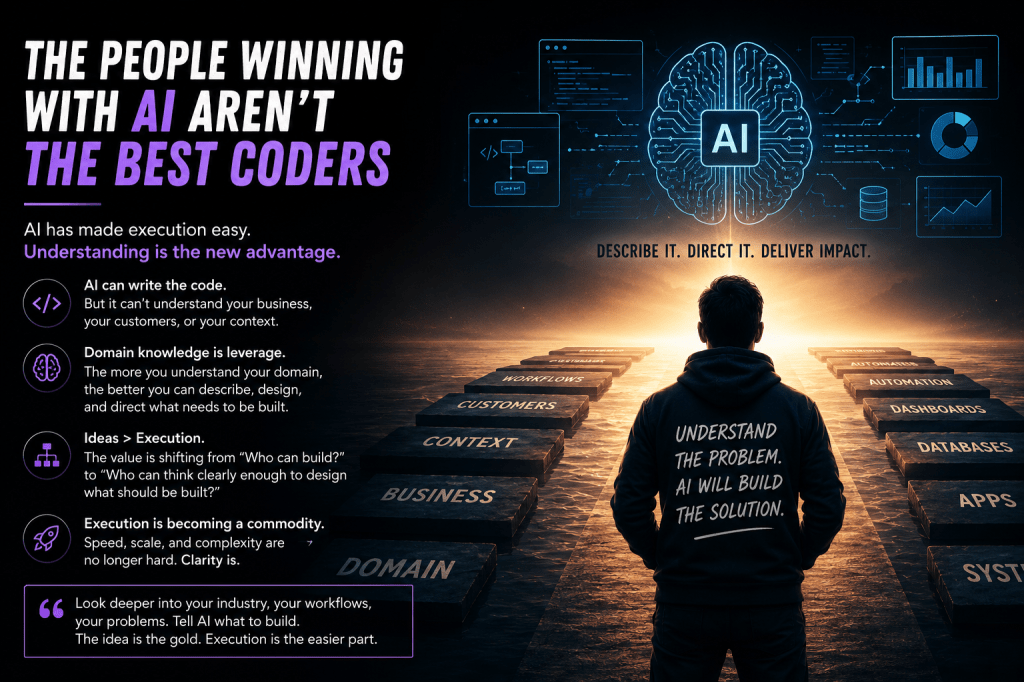
  • The People Winning With AI Aren’t the Best Coders

    The People Winning With AI Aren’t the Best Coders

    That’s the wrong conversation.

    A few years ago, building software meant technical skill. You needed engineers, architects, specialists, infrastructure teams, databases, deployment pipelines – the whole machinery.

    Now?

    You can build surprisingly complex workflows, dashboards, automations, apps, even lightweight platforms using plain language. Tools like ChatGPT, Gemini, Claude, Cursor, Lovable, Replit – they’ve flattened the technical barrier faster than most organizations realize.

    The bottleneck is no longer execution.

    It’s understanding.

    A few weeks ago, Girish made an observation that stuck with me:

    “Knowing your domain is becoming more important than being technically excellent.”

    And honestly, that might be the biggest shift AI is creating right now.

    The people getting ahead with AI aren’t necessarily the best programmers. They’re the people who deeply understand their domain. Their customers. Their workflows. Their operational pain points. Their industry logic.

    Because AI can generate code.

    But it cannot invent clarity.

    If you truly understand how your business works, you can now describe it, structure it, refine it, and have AI build around it at absurd speed.

    That changes the game completely.

    The value is shifting from “Who can build?” to “Who can think clearly enough to design what should be built?”

    Ideas are becoming leverage.

    Context is becoming leverage.

    Conceptualization is becoming leverage.

    Execution is slowly turning into the cheaper commodity.

    And that creates a second shift that most organizations still haven’t fully understood:

    When execution becomes easier, speed starts mattering more than process.

    The teams that learn fastest may soon outperform the teams that plan the longest.

    And honestly, that changes leadership, delivery, and product development more than AI itself.

    More on that in the next post.

    #Midnightmusings from the trenches of delivery.

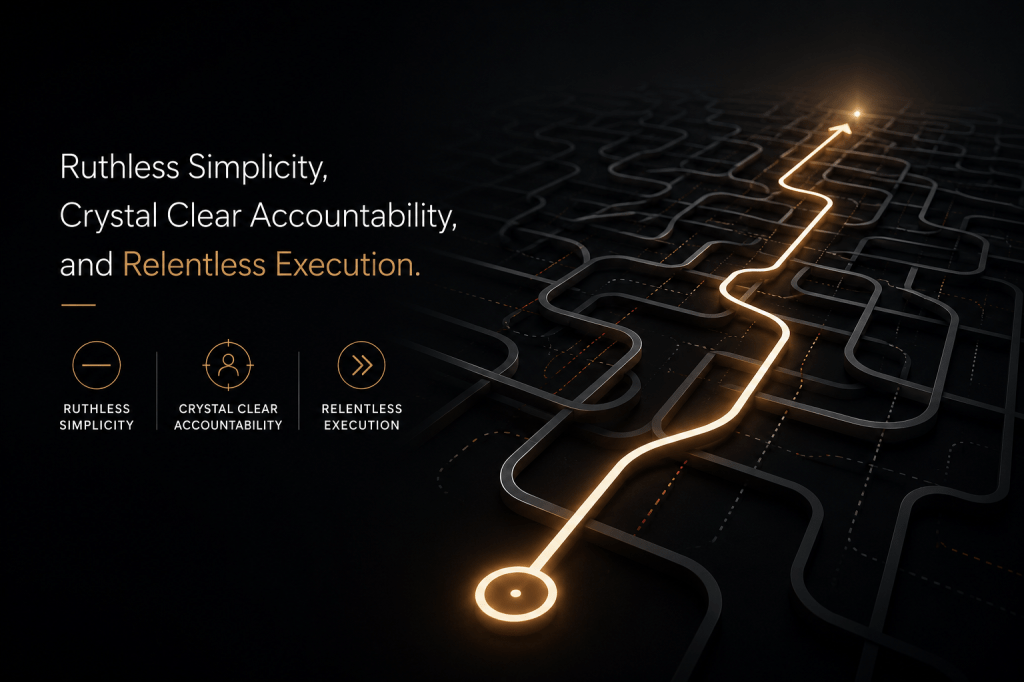
  • Ruthless Simplicity. Relentless Execution.

    Ruthless Simplicity. Relentless Execution.

    Most delivery problems don’t start with technology. They start with process drift.

    Over time, organizations quietly accumulate layers – another tracker, another template, another governance step added after a crisis. None of it feels unreasonable in the moment. But eventually delivery teams spend more time navigating process than delivering outcomes.

    At some point, someone has to ask: Is this actually helping?

    Recently, our COO Arun Chandra framed operational excellence around three principles – Ruthless Simplicity, Crystal Clear Accountability, and Relentless Execution.

    Simple words. Hard in practice.

    Because Simplicity forces you to remove things. Accountability forces you to name owners. Execution forces you to stop admiring frameworks and start delivering.

    As part of our #AIFirst initiative, we redesigned the NICE Actimize XSE delivery governance model.

    Instead of adding reporting layers, we introduced an AI-driven governance layer across the delivery lifecycle – analyzing signals from risks, timelines, and project updates to surface issues early.

    In practice, it meant collapsing multiple trackers into a single lifecycle model and letting AI highlight emerging risks before they become escalations.

    The goal isn’t more governance.

    It’s better visibility with less friction.

    #Midnightmusings from the trenches of delivery.